STORYLINE 360 EXAMPLE
Everyday Inclusion: Recognising and Responding to Microaggressions at Work
THE CHALLENGE
Creating an inclusive workplace involves more than understanding organisational policies. In everyday interactions, employees may encounter subtle microaggressions that can affect colleagues' experiences, even when no offence is intended. Because these situations are often ambiguous, they can be difficult to recognise, discuss and respond to confidently.
Policy definitions and organisational guidance can build awareness, but recognising and responding to microaggressions also requires employees to interpret context, consider different perspectives and make thoughtful decisions. The challenge was therefore to design a learning experience that moved beyond awareness, helping learners recognise subtle workplace situations, reflect on different viewpoints and practise making inclusive decisions in realistic scenarios.
MY ROLE & TOOLS
MY PROCESS
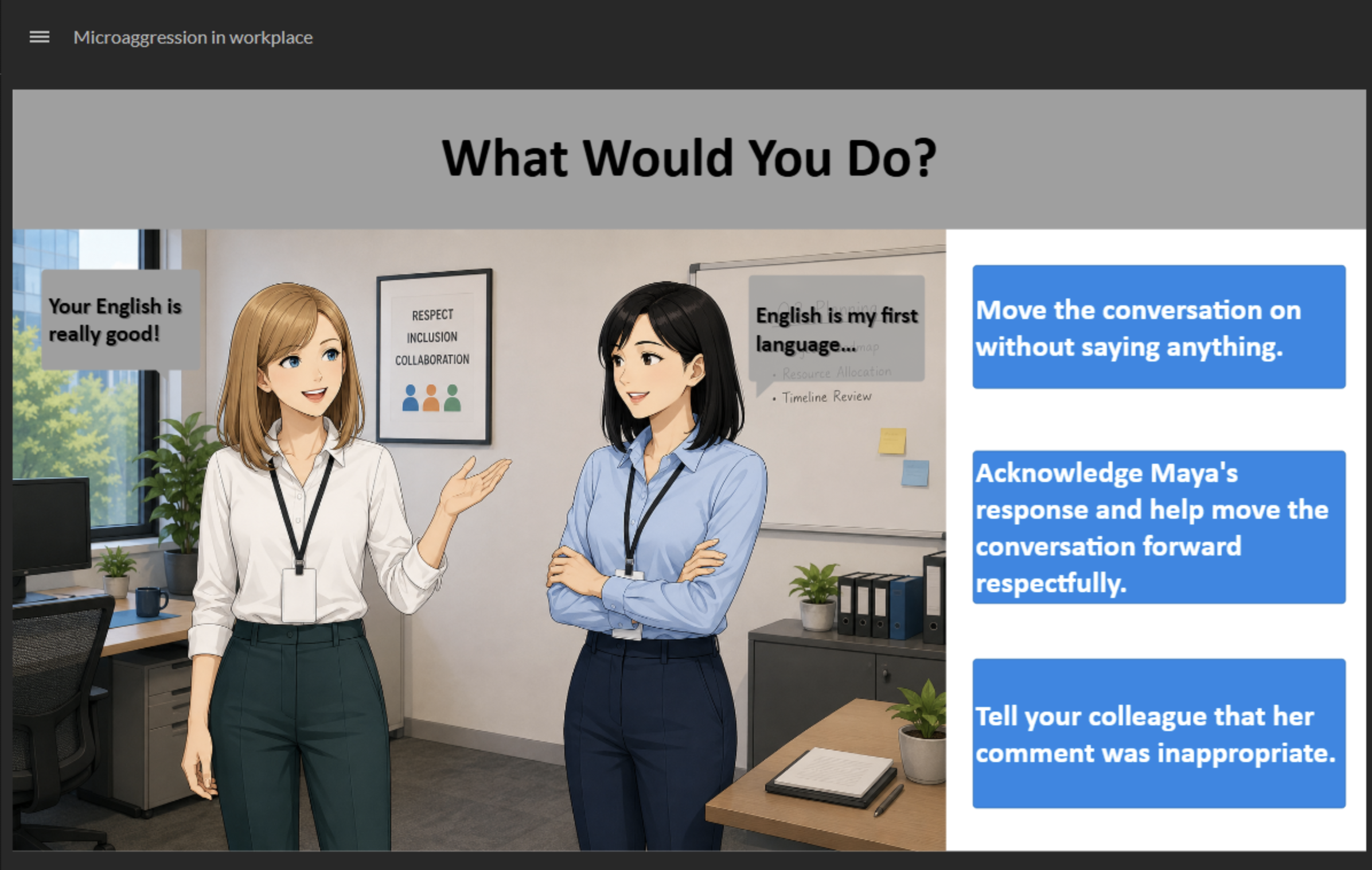
I designed the workplace learning experience around scenario-based learning, placing learners inside realistic situations before introducing the concepts behind them. Rather than presenting disconnected concepts, the course follows one employee through a typical working day, allowing each workplace interaction to build naturally on the one before it. The learning journey follows three stages: NOTICE → RESPOND → REFLECT. Learners first observe workplace situations and explore different perspectives, considering how intention, impact and repeated experiences can shape interpretation. They then practise responding to realistic situations before reflecting on the consequences of their decisions.
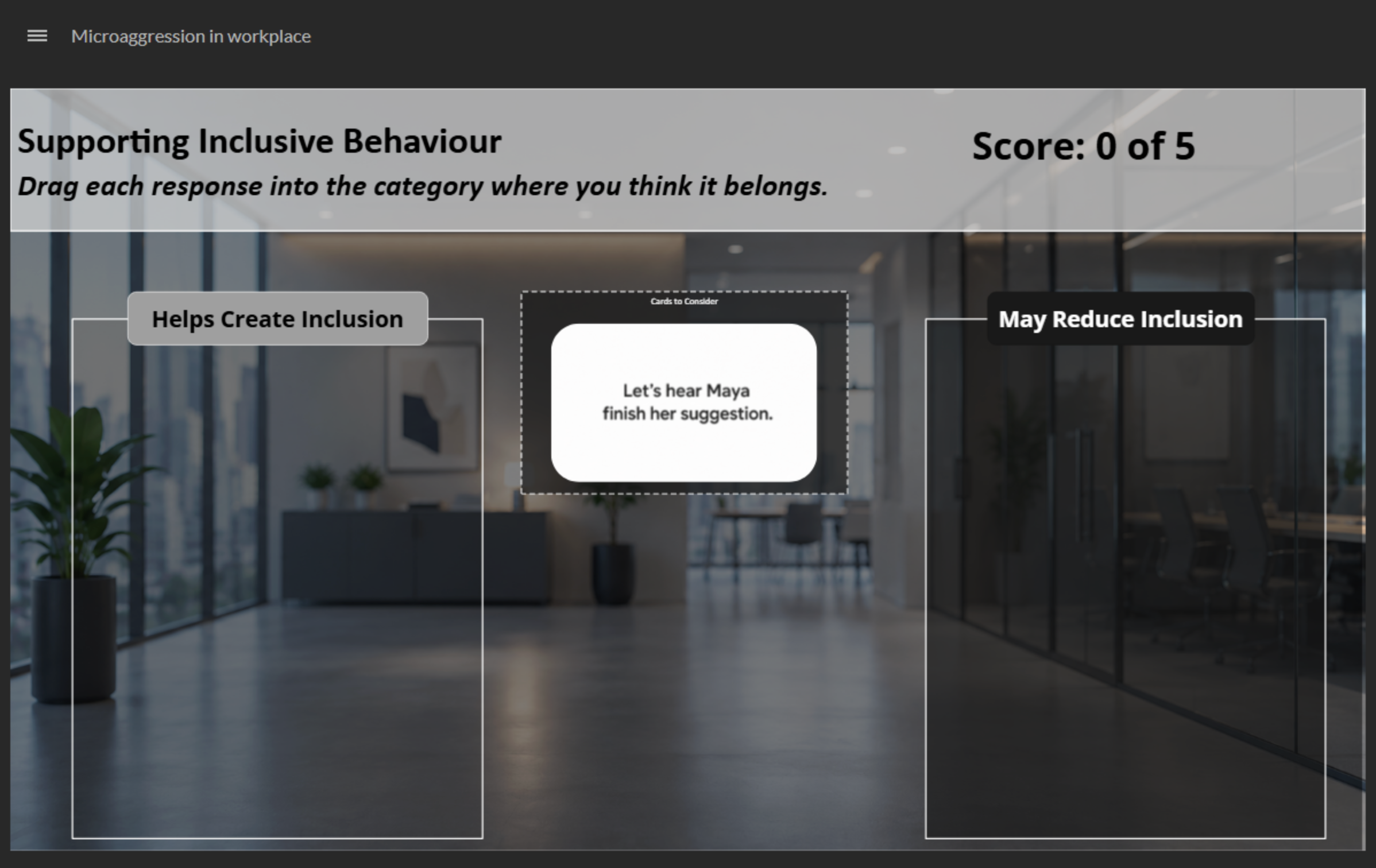
I selected each interaction for a specific learning purpose. Interactive perspective-taking activities allow learners to explore how the same workplace interaction may be experienced differently; animations reveal information progressively to reduce information overload, a drag-and-drop activity develops judgement around supportive workplace behaviours, and scenario-based knowledge checks allow learners to explore the consequences of different responses in an authentic work context.
Key concepts are introduced after learners encounter realistic situations, allowing new knowledge to build on existing workplace experience. An optional glossary brings together definitions and key examples of the main concepts, providing a reference learners can revisit throughout the course whenever needed. The course concludes with personalised reflection rather than factual recall, encouraging learners to consider how they can apply their understanding to everyday workplace interactions.
COURSE VIDEO
VIEW INTERACTIVE COURSE ↗THE DESIGN VALUE
The course supports workplace inclusion by helping learners recognise subtle forms of discrimination and exclusion that can be easily overlooked in everyday workplace interactions. Learners explore how these behaviours can affect colleagues differently, consider perspectives beyond their own, and practise responding thoughtfully in realistic scenarios.
This approach moves inclusion learning beyond policy awareness towards recognising less visible forms of discrimination, exercising practical judgement and making more inclusive choices in day-to-day workplace interactions.